While watching Il Pianeta Azzurro and digging deeper into Piavoli’s earlier short films like The Seasons and Sunday Evening, I got a sense of Piavoli’s preoccupations towards environmentalism and the natural world. Water, the cycling of seasons, our changing climate, the trees and plants, love and sex, human beings and technology, etc. The Seasons has many shots of the outdoors over the seasons as snow gives way to streams of water glimmering in the sunlight, to farmers working the land with their heavy machinery. Sunday Evening at first may seem a bit different formally with its emphasis on couples dancing together and riding motorcycles. But then the last couple of minutes hit us, and we find ourselves returning to the usual inclinations: many shots of the nearby pond, the water and plant life growing around it, as well as a young couple lying down on the grass making out.
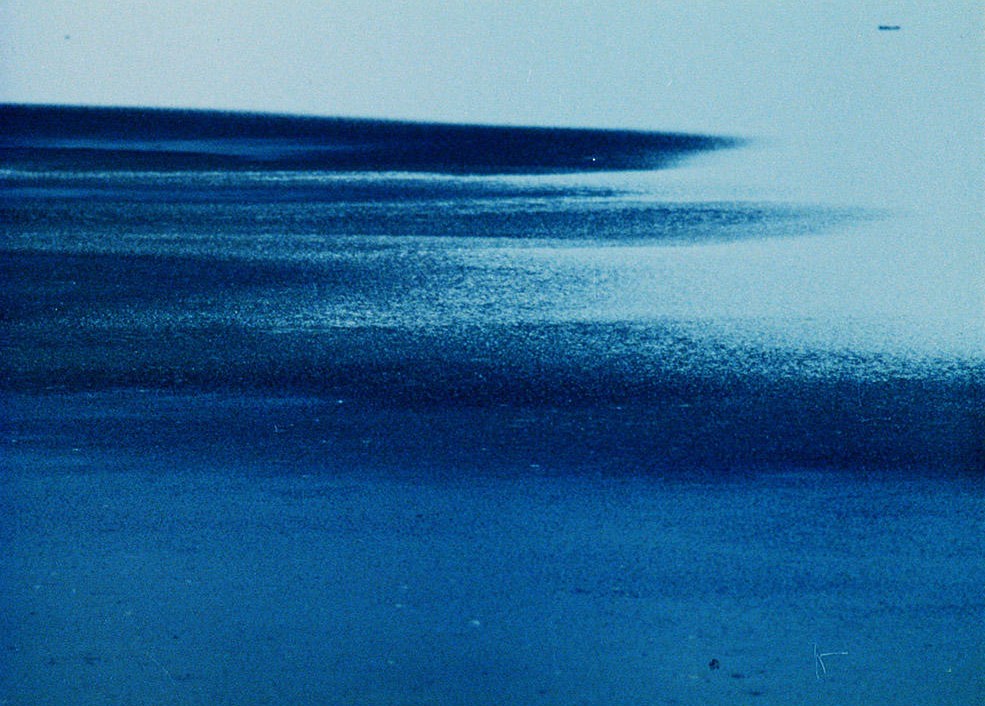
Many of these same images appear again in Il Pianeta Azzurro, except this time on a grander scale. Your sense of the passage of time in Il Pianeta Azzurro will depend on your own interpretation; the events depicted in the film may have taken a full day starting from mid-day to night and then cycling back to day again, or it may have taken way longer, maybe a year. We start off similarly to The Seasons with shots of ice breaking and melting into water. Many of these shots are punctuated by the sound effects of water dripping, at first a really loud drop which then escalates to the sounds of water rushing as we cut to close-ups of streams of water, with streaks of light reflecting on the surfaces, imagery reminiscent of something you might find in a Stan Brakhage film or Rose Lowder or many others.
Water gives way to the winds, pushing the wavy green grass on the hills and causing the shadows of trees to move in unison. Life starts flourishing as we hear the sounds of different animals howling and screeching. We witness flies getting caught inside a spider’s web. There is a compelling moment where we watch a dragonfly slowly get wrapped up by a spider’s silk while the dragonfly struggles with its every might to break free, its will to survive in the face of nature despite the circumstances. We eventually arrive to scenes of different species having sex – flies, frogs, and eventually a young human couple in the grass. Many of the shots are focused on close-ups of their faces, maintaining that sense of intimacy while coming across as if we’re watching them from a very detached, alien perspective trying to understand the phenomenon of sex as it relates to all beings.
Much of the film at this point plays out like a nature documentary, although one that’s more concentrated on the image and on us deriving our own interpretation of what is happening as opposed to having David Attenborough narrate to us a description. Where I think the film soon starts to lose its momentum is when we get to the nighttime scenes involving human beings living on the land in contrast to nature itself, a juxtaposition that I do not think the film does very much with. I think these moments also risk coming across as stage-y in contrast to everything that came before. There’s the scene of an old man getting out of his bed to open the window for a moment. For the latter we start with a wide shot of the bedroom to the side of the man, then cut to a medium directly in front of the man as he opens the window, then back to the wide shot again as he returns to bed. It’s a scene that involves elaborate camera setup and feels at odds with the naturalistic approach of everything else up to this point. You cannot stage nature, after all.
The film formally shifts again, as we move away from the farmers toiling away at the land to moments that evoke that Tarkovsky sensibility of manmade deterioration; nature taking back what was theirs to begin with. We get shots of interiors with doorways perfectly lined up in the frame as we hear sounds of rain hitting the windows or water droplets leaking through. A rusted wheelbarrow is left sitting there outdoors, about to be reclaimed by nature once again. The film ends with a series of stunning final images of the fog coming in and obscuring much of the forest, with a sole tall tree standing above the rest, peaking through.
While I wish there was less of a mismatch between the formal approaches that define its parts, it’s a film that starts off quite strongly for the first half and ends beautifully, almost like a journey from the beginnings of our planet Earth, to the first signs of life, to humanity taking over and then finally what remains after humanity is gone. Any film that starts and ends on a pretty strong note is good enough for me.