What if you made an entire film comprised primarily of driving scenes involving back-and-forth conversations between the driver and passenger? Sebastian Brameshuber’s London could be your answer. It might seem less interesting than it sounds on the surface, but there is such a precedent via Abbas Kiarostami’s highly acclaimed Taste of Cherry, a film about a man with suicidal ideation who drives around looking for somebody who can help him get the job done. In London we follow Bobby, a driver who picks up passengers between Vienna and Salzburg. Bobby’s motivations don’t seem to be derived from a suicidal intent unlike Mr. Badii in Taste of Cherry. Instead he is visiting an unnamed old friend of his whom he hasn’t seen in a while and who is currently in a coma at a hospital in Salzburg.
We first get a clear nod to Taste of Cherry with the first passenger he picks up, who is a soldier looking for a ride to work, much like in Taste of Cherry which involves a similar early scene involving a young soldier. Many of the conversations in London are also shot in a similar side-profile of their faces within the interior of the car, usually not on the outside of the car’s exterior. Unlike that film however, Bobby seems more interested in interrogating the soldier’s life and revealing who he is underneath. He has his duty and responsibility to serve his country, but he is also wrought with guilt and dissonance as far as his role towards further propagating war and chaos around the world is concerned. Such is also the case with Bobby’s next few passengers, although sometimes these conversations don’t always rise about niceties or slightly above surface-level talk about one’s occupation and family life (such as the young man who works at a supermarket).
Much of London is also shot in a studio instead of on location using rear-screen projection, with Brameshuber doing takes of up to an hour to an hour and a half, letting the actors improvise however much they want, then do another take after a review of the previous take. It’s quite a laborious process, where the lighting of the car interiors probably also had to match what was being rear projected, but the results show. Many of these conversations feel very natural, almost as if they are conversations that could conceivably happen as you’re sitting there in the car with them, observing and listening but never intruding in. There’s maybe one moment involving Bobby taking off his jacket as he is driving where the movements of the car don’t quite match what would normally occur in an actual situation like that, and thus the illusion breaks briefly. But besides that, as long as the lighting of the car interiors matches what’s being projected, it looks quite convincing enough. It may as well have been a real moving car on a real road.
There is a moment where Bobby has to pick up a Romanian passenger named Anca, who struggles to speak either German nor English to him. The language barrier does represent the first signs of dramatic tension during these conversations – for the most part the dialogue feels rather harmonious and agreeable. There’s also a very funny conversation involving a young communist who provides a rather persuasive argument for why James Cameron’s Avatar is an accidental Marxist masterpiece. I’m not entirely convinced that such a successful product of capitalist intentions is truly Marxist at its core, but considering the story is about a guy (Jake Sully) who gathers supporters and rallies against the destructive system that human beings created to begin with, I can see where the logic comes from.
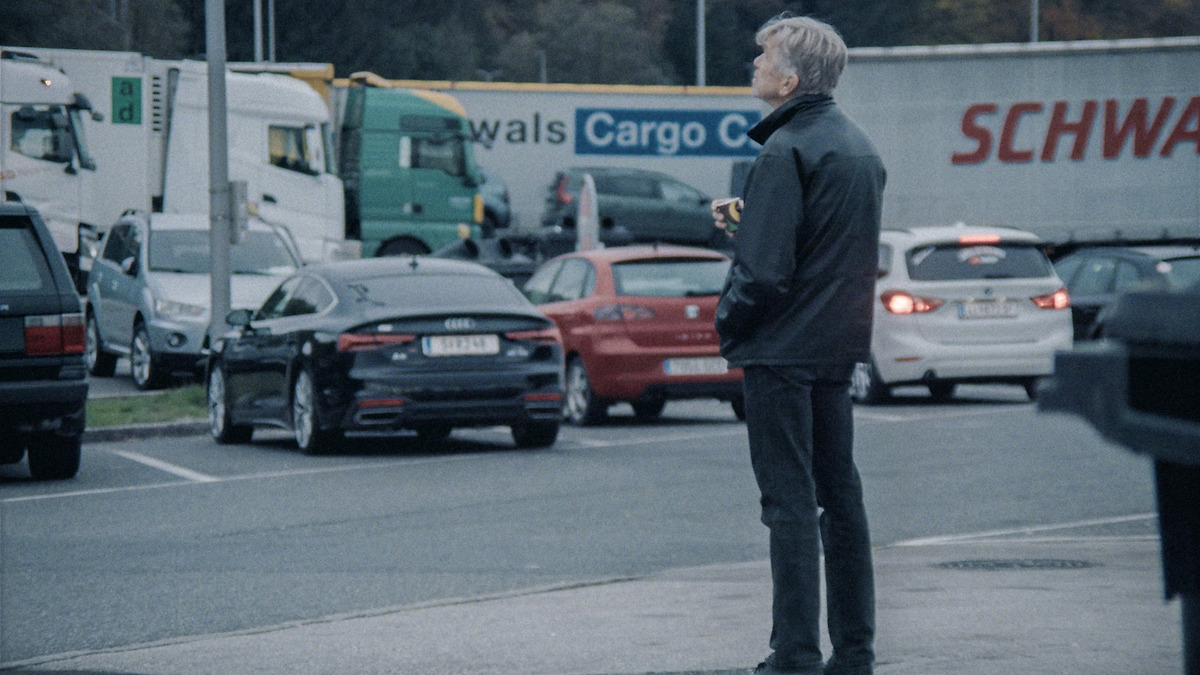
In the meanwhile, however, we do also get brief moments when Bobby is not driving and out of the car. Sometimes he’s at a café dining by himself. Other times he’s filling his car up with gas, or standing by the roadside observing the traffic go by. There’s even a scene where he helps out Cliff, a fellow acquaintance who we see pushing his broken-down car to the side of the road in the middle of the winter. He later picks up Cliff, drives him to his destination and also has a friendly chat. But much of the time we see Bobby alone. He says he’s been married once, but that was a while ago. He doesn’t have any children, and we don’t even see the friend whom he is visiting at the hospital.
It’s quite a lonely existence, and we do see Bobby having to come to terms with this during the segment where he picks up a young 24-year-old psychology student. There is a sharp contrast here between her youth and her burgeoning relationship with her boyfriend (whom she mentions in the conversation) as she turns the conversation and psychoanalysis entirely towards Bobby. It’s a pivotal moment where Bobby now has to grapple with his own mortality, especially considering his dying friend, lack of family whom he is in contact with as well as his lack of success at having found true love. This wide spectrum of emotions is a fine line that the movie walks very well, with a nice balance between the funny, heartwarming moments as well as other moments that push us to also think about our own existence and belonging in this world, much like Bobby himself – even if it makes us feel extremely old on the inside.