Some may be familiar with the other film adaptations of Octave Mirbeau’s classic novel The Diary of a Chambermaid, the most well-known of these being Jean Renoir’s 1946 version when he transitioned into working in Hollywood, as well as Luis Buñuel’s 1964 adaptation Diary of a Chambermaid. Both films take on vastly different approaches to the source material. Renoir’s version cuts back on and censors the more salacious aspects, whereas Buñuel’s version leaves in the salaciousness and taboo parts (including the murder of a young girl). Radu Jude’s adaptation this time around also takes significant creative liberties especially in terms of updating the setting and placing it in the modern-day. For me personally, this is my favorite film adaptation of this story – even more so than the Bunuel and Renoir versions.
I greatly appreciate how much Jude’s additions and revisions have turned it into something relevant for today’s context, even down to the little moments like the catcalling and insulting on the street from a rowdy man as our protagonist Gianina walks by (something that is pretty much a staple in Jude’s films). Much of the story of The Diary of a Chambermaid in this case only follows a very vague outline that is like the novel and the other film adaptations; about a housekeeper hired by a rich family with social commentary underneath that speaks to the exploitation of labor and the divide between the poor and the rich. This time around, we follow Gianina, a single mother who takes on this job for money in order to care for her daughter Maria and grandmother back home in Romania. Being in France has separated Gianina away from her family for an extended period of time, so Gianina makes promises to her daughter that she’ll be home by Christmas.
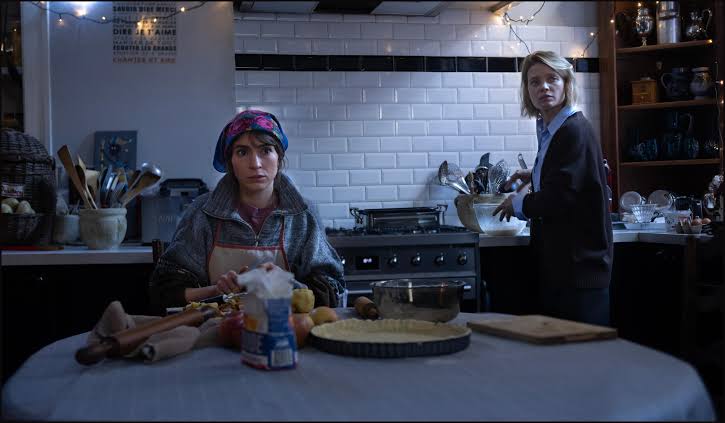
We see Gianina doing many household chores – vacuuming and cleaning, framed in a manner that feels like an ode to Jeanne Dielman. While Gianina is cooking and doing these various tasks for the Donnadieus, she is also tasked with taking care of their son. She tells him a lot of fairytale stories, particularly one from back home in Romania regarding a man who encounters a palace where three women live, shrouded away from time and space through which he can have anything he wants and his desires fulfilled. There is an interesting use of modern-day footage of what looks like Romania with a lot of dilapidated abandoned buildings where those buildings used to be full of life, now neglected while Gianina tells this story. (Perhaps there may be some allegory there with Romania’s own economic situation and history over the years, however I would have to think more on that point.) Gianina is spending so much time with him that she is taking care of him more so than her own daughter back home, which becomes a source of contention for their relationship later on.
During this time, Gianina is also involved with a local amateur theatre production of Diary of a Chambermaid, where Gianina plays Celestine, the maid in the original version of the story. Radu Jude’s metareferences here are quite interesting, almost as if there’s a self-awareness when it comes to how much his own version of the story differs – and even incorporates a mention of Buñuel’s adaptation, specifically the line about Jews in Romania in the film. Much of Jude’s anti-bourgeois sensibility certainly relates well to Buñuel’s views and satirical take on the subject matter. The play leans into the explicitness and vulgarity in very absurd ways, including a ‘sex’ scene on stage revolving around Gianina as Celestine riding a broom with the actor playing Georges on the rocking chair.
Things get complicated once tragedy strikes the Donnadieus, and in very typical bourgeois fashion they ask Gianina to delay her trip back home to visit her daughter. This complicates things even further, and thus creates a snowball effect that affects even Gianina as well. There’s something emotionally crushing and heartbreaking about this last third of the film as we wonder whether or not Gianina will ever see her daughter, and whether or not she can break free of this cycle of exploitation. The ending, however, is one of Jude’s tenderest moments – perhaps even one of his most optimistic. Such an ending in fact might solidify this as Radu Jude’s Christmas movie. It’s not so much that the Donnadieus are evil people – after all it isn’t the reality most of the time, but the film also doesn’t exactly exonerate them either. They are still complicit within a system that demeans the lower classes of people like Gianina, and if they had thought better, perhaps none of this would have happened.