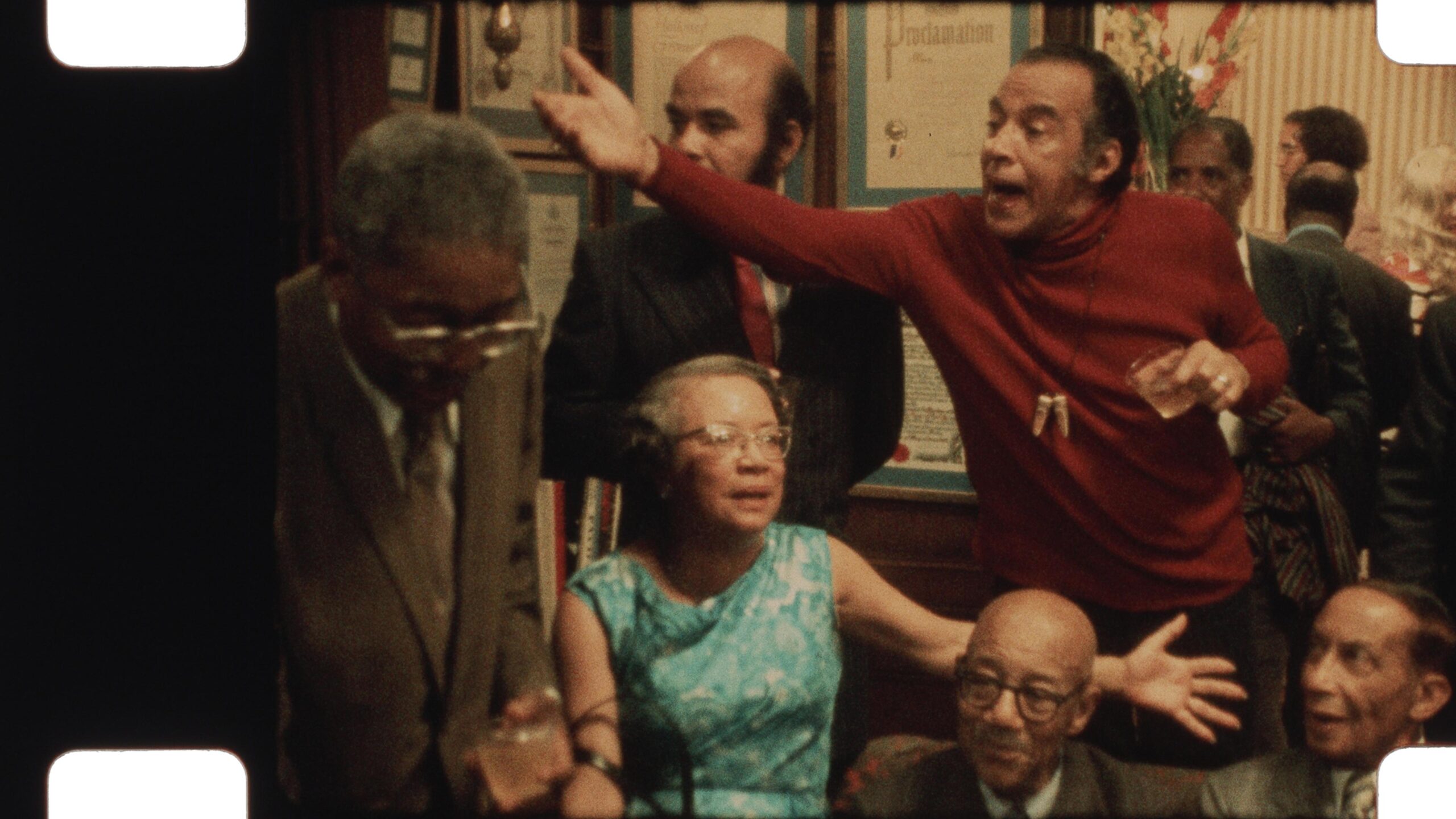
I was intrigued by the announcement at Cannes earlier this year concerning an unearthed film project by the late William Greaves that was first shot in 1972 and remained unfinished and unreleased until now. This is all thanks to the efforts of his son David Greaves, who also served as a cinematographer on the film at that time and is also credited as co-director of the film with his father. I’m a huge fan of Symbiopsychotaxiplasm: Take One, a film that stands the test of time in terms of its experimentation with the documentary format that feels fresh even today. The premise of Once Upon A Time In Harlem is also quite historically remarkable, as it involves a gathering of some very important figures of the Harlem Renaissance of the 1920s and 1930s. These figures include the painter Aaron Douglas, the poet Richard Bruce Nugent, musicians Eubie Blake and Noble Sissle (who were frequent collaborators together at one point), photographer James Van Der Zee and many others. I can only imagine the great lengths William Greaves went to put these people together in one room – many of them haven’t seen each other in decades up to this point.
I am unfortunately no expert of the Harlem Renaissance, and I will mention that this may not be the best starting point for getting acquainted with the movement, even for someone such as myself. There is even a segment in the film where they discuss the meaning of the movement and whether or not what they did can be truly considered a ‘movement’. However, even without the prerequisite background, there is quite a lot to pick up from just the conversations and the relationship dynamics. Much in the same manner as Symbiopsychotaxiplasm, there are moments where we see and hear William Greaves interject himself within these conversations, asking questions and trying to steer the conversation in a certain way. You also see his film crew including his sound guys in the frame, almost like the occasional reminder that this is a film we’re watching, although it doesn’t quite have the same effect nor playfulness here that it does in Symbiopsychotaxiplasm. Perhaps, much like that film however, it is meant to tell us exactly who is in control of the situation all along: who else but the director of the film?
Much like in Symbiopsychotaxiplasm there is also the use of split screen, with the approach of using multiple cameras at different angles to capture the action. The split screen approach admittedly feels less effective here than its use in Symbiopsychotaxiplasm – it’s not quite as illuminating at revealing what it is we are not seeing in contrast to that film. Because all the action and dialogue are centered within the same room, all the split screen does in this case only goes as far as to show people talking in one frame on one side of the screen while we see people reacting to what they’re saying on the other side of the screen. Sometimes it is also used to provide further context, such as displaying a photograph of themselves as younger while they are speaking – which isn’t really truly taking advantage of the split screen so much as a similar effect could have been achieved by just cutting to the photograph and back to the footage. There are also talking heads portions where many of these figures have individual sit-down interviews with Greaves off-camera asking them questions. Many of their heads and faces are often centered in frame, illuminated by the soft lighting while also cutting back to old archival photographs to provide additional context for what it is they’re saying during the interviews. The editing during these portions does feel a bit more conventional in contrast to the more experimental segments of the film that clearly have William Greaves’ touch to them, and makes me wonder what William Greaves himself would have done. But this is no knock on David Greaves’ work either when it comes to assembling all this together into a proper film, regardless of the conventionality. I’m sure there’s plenty other interesting moments that could have been pulled out of the 60,000 feet of footage that Greaves had shot, but what’s here is noteworthy.
While there’s enough here to indicate that these conversations are quite authentic and truly in the moment, it does make me wonder how much of it may be played up for the camera, especially as the conversations move along and drinks start piling up. It only makes sense; many of them never got the accolades and respect that they deserve, and being on camera for a film is really an opportunity for them to tell the world who they are and what they did. This is further exemplified by the appearance of Ida Mae Cullen, the widow of novelist and poet Countee Cullen who tries to stake the claim during the rowdy conversation that her late husband deserves to be acknowledged as much as anyone else at the table. I was also particularly struck by Leigh Whipper, an African-American actor and important figure who was also part of the Harlem Renaissance. He would have been 96 years old at the time of filming, but even at that point his mind was still very sharp, especially during the scene where he recalled a poem written by his neighbor and friend from decades before. Of note as well are some of the women who appear in the film, alongside Ida Mae Cullen there is also activist and professor Louise Thompson Patterson. The women are able to hold their own in these group conversations that often feel very male dominant and overemphasizes the voices of these men, shedding a light on a different perspective that would have been overlooked otherwise. As a historical document, I’m ultimately glad that after 54 years this was able to see the light of day, even if for what it is, it does make me wonder of what could have been – or perhaps what could not have.