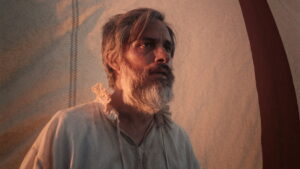
Irakli is looking for his 28-year old daughter, Lisa. She was working on a photography project on football fields all across the country when she suddenly disappeared. She hasn’t reported to her workplace for more than a month now. Together with his invisible buddy Levan, they both set off on a road trip across the country, visiting many football fields along the way in an attempt to find her despite a plea from Lisa in her letter to Irakli telling him not to search for her. Along the way we see Irakli interact with other invisible people and with other children playing football in the fields, asking about his daughter’s whereabouts – none of them have any clue, not even the disembodied voices. He makes a quick stop by his uncle’s. Irakli drifts around from place to place, like a ‘dry leaf’ in the wind, the title itself being a reference to a football pass that was coined in the 1950s by legendary Brazilian footballer Didi.
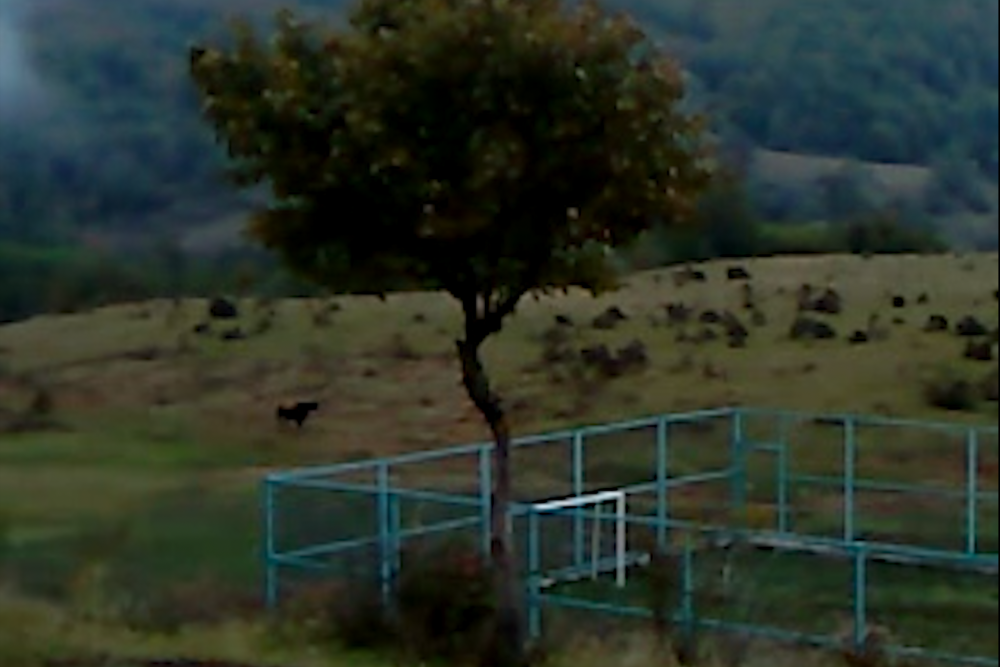
One thing that will immediately stick out for any viewer is the visual aesthetic – the entire movie was shot on an old Sony Ericsson phone, creating a fuzzy and heavily compressed digital look to each shot. Director Alexandre Koberidze utilizes the limitations of the camera’s recording quality to great effect in some of these shots, giving an interesting texture to many of these images that go beyond any number of old YouTube videos you can find on 240p quality. Some of the shots here remind me a lot of impressionistic paintings, like a moving Monet during the outdoors portions observing the trees and grass out in the countryside. There are some incredibly gorgeous shots and compositions here that did leave me in awe – in particular is a long-take of women going up on a platform to sing a song as the camera pans to a dog, whose head pops out of the bushes. (Many moments here of dogs and horses and other animals throughout the film.) Also shots of Irakli’s car driving in the distance, reminiscent perhaps of Abbas Kiarostami’s Taste of Cherry with the sandy landscapes. There’s a shot where it looks like very evenly flat green terrain as the SUV passes through in the rain – the ground itself probably wouldn’t look that flat in reality, but the blurriness of the visuals adds a rather surrealist look to the landscape. There are some others where the shadows are heavily crushed that it makes for some distinct visuals, like the shot of Irakli walking with the two kids into the forest, their backs illuminated by sunlight while the forest has become all pitch black. As well as other shots of the trees, where the brownish autumm colors as a result of light from the sun stick out against the pitch black shadow of the night. The pixelation adds this hazy quality that almost makes it seem as if you’re watching a series of memories happen, further exemplified by the textures during the car wash scene and the soap and water covering up the background behind the windshield.
Nostalgia also serves as a central component of the film. Irakli longs to reconnect with his daughter whom he hasn’t seen in a long time. The themes concerning football – clearly a favourite pastime of Koberidze’s and much of Georgia – centre around what football used to be and its representation as a pastime that connects communities together, what with the appearances of old memorabilia and pictures of celebrated football players like Diego Maradona, in contrast with what the football fields in the film look like in their present-day. Rusty, derelict and sometimes makeshift, as if football has become a forgotten pastime the more Irakli continues down his journey. The further he goes, the more derelict they get and the fewer people he sees playing in the fields. I was also reminded quite a bit of Koberidze’s past film What Do We See When We Look At The Sky?, which emphasizes this theme of football as a source of human connection with the many scenes of children playing football and the groups of people crowded around any screen playing the World Cup.
I do find the narrative in general to be pretty weak and not that compelling – it seems like the sole purpose of structuring the film in this way is to have some structure for the images being presented rather than to have the approach be scattershot, even if it’s just any structure. I don’t feel like I quite connect to Irakli’s journey and his struggle to find his daughter in the same way that I connected with the love story of Lisa and Giorgi in What Do We See When We Look at the Sky? and the forces of destiny that brings them together and also separates them apart. After all, it’s hard to do so when we don’t understand the context of Lisa’s relationship with Irakli, or why Lisa doesn’t want to contact Irakli – maybe there’s a good reason why, if Irakli is completely ignoring Lisa’s letter demanding that she doesn’t want to be found? So when the narrative isn’t strong enough to support the film, a film like this has to really rely on the visuals – and I don’t think every single shot here is a great one. There’s only so many shots of similar landscapes, of the trees and fields that I can really be blown away by. You can even take out a football field along the way and Irakli’s journey would probably run very similarly, especially when many of the fields that Irakli visits seem hardly distinct from one another over the course of this 3+ hour film.
I’m personally a fan of when films can linger on a beautiful composition so that we can enjoy the finer details. Here I found the fast cuts don’t allow for some of these shots to breathe. They’re gorgeous to look at, but it seems like the editing doesn’t agree. I particularly loved the shots of the landscapes with the low-hanging clouds rolling by, but the film never seems to give us enough time to appreciate them. I suppose it makes sense given how Irakli considers it an urgent matter to find Lisa, and so the film’s pacing might be trying to communicate to us this urgency, but Irakli’s wandering clearly shows he is in no rush; this is not some thriller where time is really of the essence. Part of me thinks if you’re going to commit to this painterly aesthetic that the film should give the shot compositions their due.
In conclusion: when your uncle serves you some apples that don’t look quite as fresh as the ones you have at home, it’s a reminder that journeying into the unknown in search of someone you love can be exciting in its own way, but also it’ll remind you along the way that there’s truly no place like home. It’ll take you a three hour long lo-fi trip in order to come to this conclusion. Tread carefully.