The following review contains spoilers for the film.
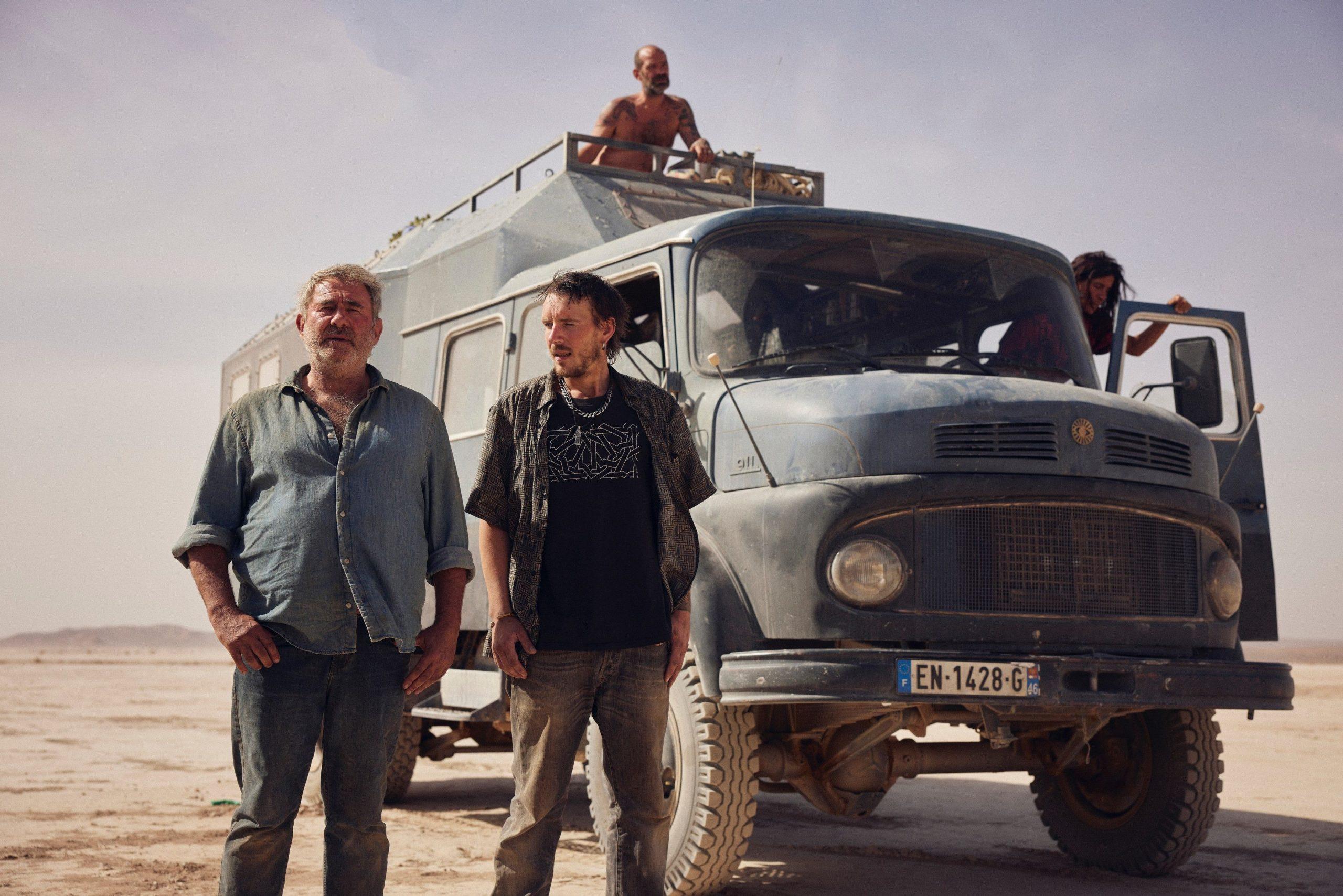
We begin with a rave in the middle of the desert. A man named Luis is with his son Esteban. The man shows attending ravers a picture of his daughter, whom he is looking for and was last seen at a similar rave. It’s quite the vibe killer to do this at a rave of all places, if you ask me, but Luis’s concern is certainly understandable and perhaps forgivable in his situation. Luis and Esteban decide to follow another group of ravers, on their way to another rave, hoping that he’ll be able to find his daughter and reconnect with her there. The journey is quite long, and the further he continues along this path to the rave, the chance of them ever finding his daughter diminishes – for very dire reasons.
Here Laxe sacrifices the dreamlike visuals and atmosphere that distinguishes his earlier work like Mimosas and Fire Will Come in favor of the auditory experience that many reviews thus far have been ‘raving’ about. The emphasis is more on making the audience feel and vibe with the rave just like the characters themselves – it’s the selling point to watch this not only in any movie theatre, but preferably one with the best audio system equipped to handle the intricate sound design backed by the soundtrack from Kangding Ray. Structurally the narrative of Sirāt runs quite similarly to Mimosas with regards to following these characters on a journey across different desert landscapes, over mountains and flat-lands. They wander around in search of that destination, only for a tragedy to strike – and that tragedy strikes very loudly in both films, as we spend the next moment reeling in emotionally from the shock of what just occurred. We start off with a certain objective – in this case, the dad looking for his daughter much like the transport of a Sheikh’s body in Mimosas – and by the end we realize it is less about that objective to begin with and more about the journey of facing “death” and one’s own fate. Only this time around, facing one’s death comes across less as a matter of embracing death or anticipating that it will happen, because it will happen to all of us – but death this time around comes in the form of very sudden and random events like a Final Destination movie. First a car falling off a cliff, next you have landmines!
Fire Will Come was also about a main protagonist seeking to reintegrate with a community, only to find that community shunning and rejecting him which results in some very bad consequences for everyone involved. Sirāt‘s Luis and Esteban also have to deal with being outsiders in a community that they are clearly not members of – and not only that, for they also have to endure the harsh environment of the land alongside the ravers they are following. By the time we arrive at the landmines, our characters are given a strong dose of reality; that in this life we have to deal with many terrible circumstances. We are not as free as we would like to be, nor is life so idyllic – the landmines are a reminder of war and a realization that things are not always safe across borders. While the cinematography of the desert landscapes look great, I wish Laxe still had his knack for landscape cinematography that made his past work so beautiful to look at – there is a lack of his usual flair for long-takes where you get to admire the scenery. Much of the focus again is not just about the music (for which the building blocks of that musical emphasis can also be found in his previous film Fire Will Come), but about the really loud sound design that preoccupies much of the second half in general as the film turns into more of a war thriller.
And it is this shift that the film comes across as hardly anything more than sheer shock value, a kind of unearned manipulation from where we initially started. The search for the daughter ultimately doesn’t matter when the cost is so high; nor does it feel like a celebration of rave culture when those are the consequences. One cannot sustain that high forever – eventually that escapism will all come crashing down where you will have to face the reality of what has transpired as a result of your actions. Or, if you have any sense like the characters should have had in the film, they could have easily backtracked their steps during the landmines portion without needing to barrel their way onward and taking the risk. I’m sure there’s an easier way to get to that rave.