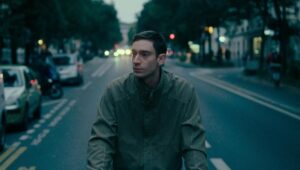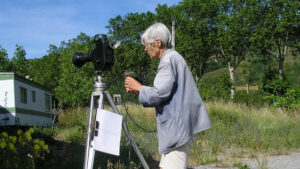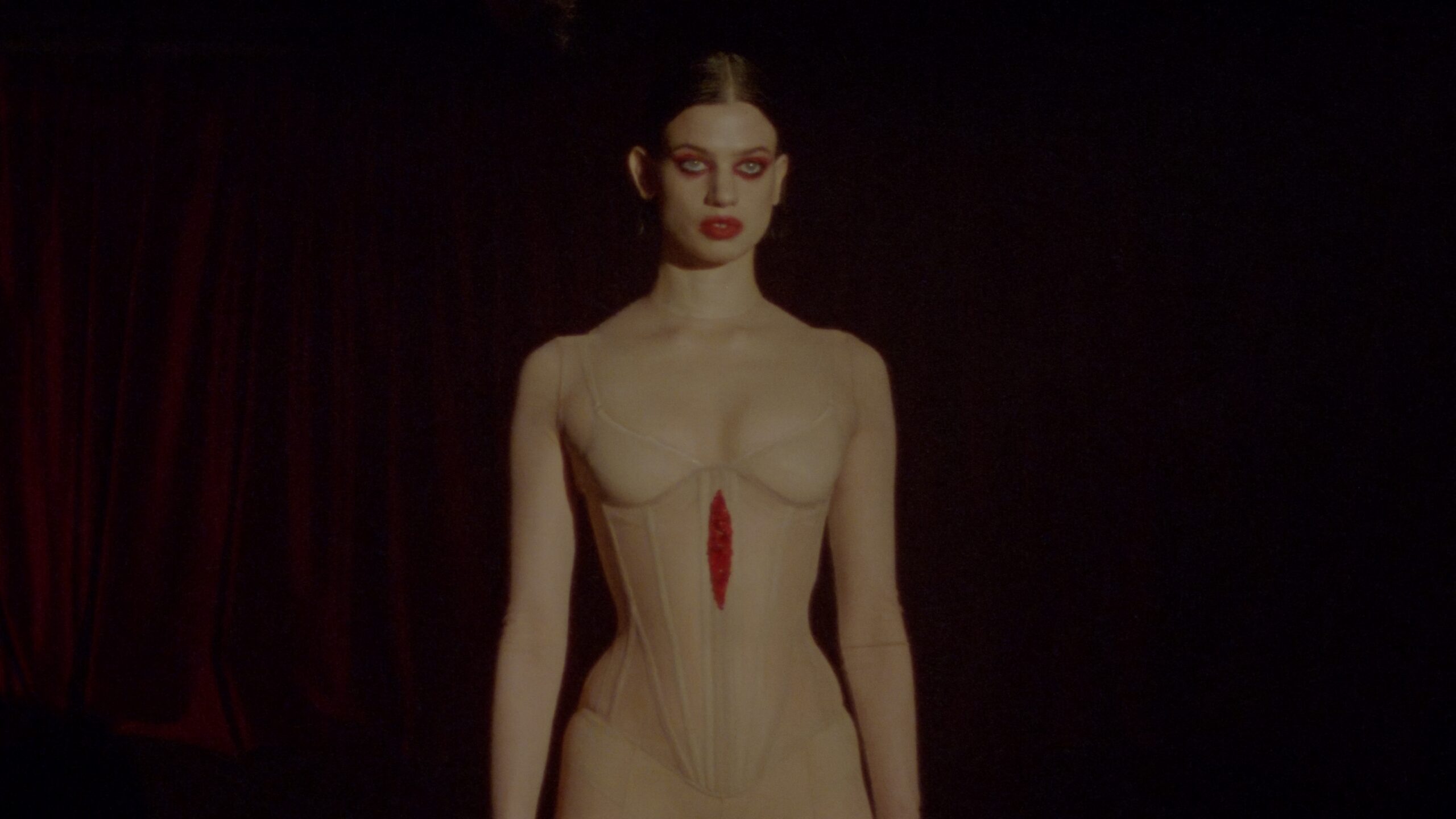
At Night tells the story of six women living in Paris. They gather around a table in a café during a scene where they hold an intimate conversation about various subjects. They speak their mind on sex, relationships and aging in ways that are quite revealing about themselves, as if they are very close friends. They talk about motherhood and pregnancy, as well as personal pleasure (in the case of one of them who recounts the experience of ‘orgasmic childbirth’). Many of the people who appear in the film are actually personal friends of director Beatrice Gibson, whose voiceover also appears in the film as the character ‘Bea’ during a phone conversation where she talks about trying to make her next feature film and the creative roadblocks she faces along the way. Many of Gibson’s friends are artists themselves including the late poet Alice Notley, whose poetry is featured in the film (including the opening), fellow experimental filmmakers Pauline Curnier-Jardinand Laida Lertxundi and more. A significant portion of the film is also centered around Didi’s story, played by Diocouda Diaoune. The camera follows her around from location to location, including a scene where she and Gibson are sitting down inside a supermarket late at night after closing time, sitting by the freezers and having a one-on-one conversation much like the café scene. Didi’s perspective and dialogue revolves around topics such as the racism she faces as a black woman, being a single mother and growing up without a supportive family compared to the others. It’s a strong juxtaposition with Bea’s higher socioeconomic status and growing up in a much more supportive environment than Didi.
Gibson’s approach is an interesting one: the film is described as an autofiction in that much of the film is scripted and these people are acting. Yet many of them are playing a version of themselves, and while watching the film it’s hard not to think about the connections between what these people are saying and the authenticity at the core of it. Many of Gibson’s friends are not professional actors, yet the anecdotes they’re sharing to us on camera feel very spontaneous and reflect real experiences – if not to them, then certainly to those watching. The close-ups of their faces also reveal many of their expressions lying underneath both when it comes to the recollection of their own stories as well as their reactions listening to others.
The film’s sequences take place entirely during the nighttime, starting with shots of the Parisian underground trains moving through the tracks, to the stations. Much of the movie is shot on analog film with its grainy textures, focused on beautifully illuminated and lit storefronts as seen outdoors. The cinematography here does remind me a bit of Deborah Stratman’s short film In Order Not To Be Here. While At Night isn’t about mass surveillance, there’s an urban liminality that is captured in many of these shots especially with the sharp contrast between the lights, the darkness, the distinct lack of people and the way buildings are centered within the frame. Many of these shots are disjointed from one another, and the film doesn’t provide context for these locations, whether we are watching people closing a Chinese storefront late at night or observing people playing pool somewhere else. But it’s less about understanding where everything has to be, and more about evoking the mood and feeling of what it’s like to be wandering around these streets late at night in Paris.
Ben Rivers is the cinematographer for At Night and is an accomplished experimental filmmaker in his own right. One thing I want to highlight is the extended concert scene in which artist and musician Adam Christensen performs music in front of a standing audience. The scene does remind me of Ben Rivers’ own feature film A Spell to Ward Off the Darkness, which features a very similar scene involving a black metal concert where the people in that film are also not moshing or moving around in the way you’d expect from a metal concert, but instead standing there and just simply living in the moment. Rivers’ sensibilities and proclivities concerning human communal experience and how music brings people together maps on very well with Gibson’s own interest in the nighttime as a setting for fostering community within unexpected places. Both films also engage in a dreamlike logic of wandering around from place to place, observing the ways people live and connect to one another.
The film isn’t quite going for something like Martin Scorsese’s After Hours, but much like that film At Night is concentrated on giving us a sense of what the encounters of the night can provide in their own special and significant way. It’s a film not about confrontation much like After Hours (with the exception of the scene involving Didi and a group having a smoke outside a storefront), but instead it’s about connection. It’s a film that emphasizes immersion into group dynamics, witnessing a person at their most confessional and vulnerable in front of others where you would otherwise not see them in such a position. The nighttime can foster all kinds of feelings. It can be both beautiful and terrifying all-in-one. It can be both threatening towards one’s own inner security as well as a safe space for people to reveal their innermost secrets. It is therapeutic and transformative in that way. I’m not much of a night owl personally, and after watching this film I don’t think I would want to force myself against my own biology to become more of one. But At Night provides the best argument thus far for an openness to the possibilities and learning opportunities that can happen late into the night.